


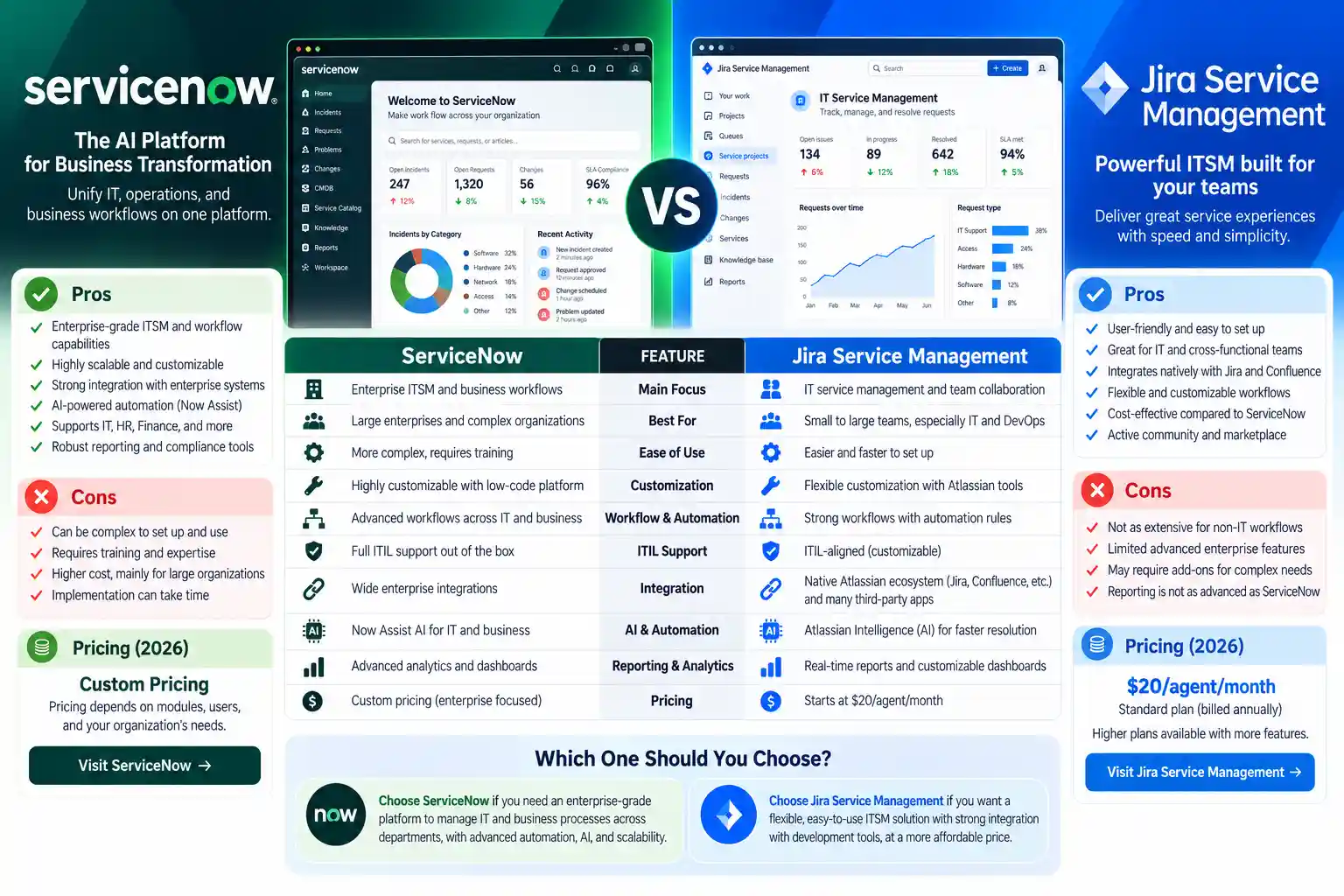
Every comparison table you’ve seen is lying to you. Not maliciously, just structurally.
Put the two platforms side by side, and you get a grid of green checkmarks. Incident, problem, change, request, knowledge, CMDB, SLAs, a virtual agent, an AI add-on. Both vendors tick everything. A procurement team with a spreadsheet and a deadline will read that grid and conclude the decision is about price and vibes, which is exactly the wrong conclusion. The checkbox tells you a feature exists. It says nothing about what it takes to make that feature behave in your company, with your org chart, your auditors, and your engineers who hate filling in forms.
So let’s skip the grid.
What you’re really choosing between
ServiceNow is a platform that happens to do ITSM. Jira Service Management is an ITSM product that grew out of a developer toolchain. That sentence sounds like marketing, but it explains about 80% of the pain and joy you’ll experience on either side.
ServiceNow wants to be the relational system of record for the whole enterprise. IT, HR, security, legal, facilities, customer service, all sitting on one data model with one workflow engine underneath. It’s built on a deep class hierarchy and a lot of native low-code extensibility, and it assumes you’ll build things on it for years. JSM assumes the opposite. It assumes your people already live in Jira and Bitbucket or GitHub, that speed matters more than ceremony, and that a service desk should be stood up in weeks instead of quarters.
Neither assumption is wrong. They’re just different bets, and the bet you need depends on who’s going to be yelling at you in eighteen months. Auditors, or developers.
The money conversation nobody wants to have
Honestly, the license number is the least interesting part of total cost of ownership. It’s the number that gets quoted, so it’s the number everyone fights about, and then the real spend arrives through the side door.
ServiceNow: the sticker is the opening bid
ServiceNow pricing is quote-driven, which means there’s no honest “per agent per month” figure you can plug into a model. You get tiers, and the names have shifted over the years, but the current shape is Foundation, Advanced, and Prime-style packaging, each one adding capability and each one adding to your annual operational expenditure. The usual pattern is that you buy at one tier, discover a workflow you need lives one tier up, and now you’re renegotiating. That’s licensing tier creep, and it’s baked into how the product is sold.
Then come the add-ons. Discovery for automated probing of your infrastructure. Security operations. IT operations management. Now Assist, the generative AI layer, which brings consumption-style credits and the very real possibility of token consumption overage if your adoption goes better than your forecast. Success gets billed. Funny how that works.
Then the true-up. Contracts commonly carry price escalators, and if your headcount or usage drifts beyond what you committed to, the reconciliation lands during enterprise contract negotiations at the worst possible moment, usually right when your budget cycle is closing. Negotiating hard on the first deal matters, but negotiating hard on the renewal matters more, because by then you’re deeply entrenched and the vendor knows it. Vendor lock-in risk is not theoretical here. Ask anyone who’s tried to migrate off after six years of custom scripts.
And people. This is the one finance teams forget. A serious ServiceNow instance needs platform administrator overhead that looks a lot like a small engineering team: architects, admins, developers who know Glide scripting, someone who owns upgrades, someone who owns the CMDB. Plus the system integrator implementation fees at the start and, very often, a partner retainer that never fully goes away. I’ve seen the people cost run level with, or above, the licensing cost. Budget for it or be surprised by it.
JSM: friendly numbers, with fine print
Atlassian’s seat-based subscription pricing is public, which is refreshing. Standard, Premium and Enterprise tiers, priced per agent, and you can honestly model it on a napkin. Lower barrier to entry, lower barrier to administration, and a project admin who’s comfortable in Jira can usually figure out a service project in an afternoon.
The catch is the Marketplace. Out of the box, JSM can be thin where large enterprises get picky: advanced reporting, deep auditing, granular SLA clock behavior, fancier approval logic, richer asset discovery. The answer to most of those gaps is a third-party app. One app is fine. Eight apps from six vendors, each with its own subscription, its own upgrade cadence and its own security review for SOC 2 Type II purposes? That’s the Marketplace tax, and it compounds quietly.
There’s a second cost curve too. JSM stays cheap and simple while you’re one organization with one admin group. As you spread across business units, each one spinning up its own projects, its own request types, its own naming conventions, administration fragments. Nobody owns the whole picture. The invoice is small and the cleanup is not.
So which is cheaper? Depends entirely on whether you count people. If you only count licenses, JSM wins almost every time. If you count the full cost across five years, including the staff you’ll need either way, the gap narrows a lot at small scale and, at very large scale with heavy governance needs, sometimes flips.
The CMDB argument, which is where most of these projects actually live or die
ServiceNow’s configuration management database
If there’s one reason big regulated companies pick ServiceNow, it’s this. The configuration management database sits on the Common Service Data Model, a structured class hierarchy where a server is a kind of computer is a kind of configuration item, with defined attributes and relationships all the way down. It’s rigid, and the rigidity is the point.
The thing that makes it actually work is the Identification and Reconciliation Engine. When five different automated discovery streams all report the same Linux box, with slightly different hostnames and conflicting serial numbers, IRE decides which source wins for which attribute and whether this is a new CI or a duplicate. Without it you get four copies of every server and nobody trusts the data. With it, you get a fighting chance.
What this buys you is real infrastructure dependency mapping. Business service to application to database to hypervisor to storage. When something blows up at 2 a.m., blast radius visualization tells the major incident team which customer-facing services are about to feel it, instead of someone guessing in a chat room. That’s valuable. It’s honestly the single most defensible argument for the platform.
But.
Data swamp syndrome is real. Run continuous discovery without governance and your tables balloon, stale CIs pile up, relationships break, and the pretty dependency maps turn into spaghetti nobody believes. The tool doesn’t enforce discipline by itself. It gives you the machinery for discipline and then leaves you to actually do it, forever. Plenty of organizations own an expensive CMDB that their own engineers refuse to consult.
JSM Assets: flexible, and proud of it
JSM Assets, which grew out of the old Insight product, takes the opposite approach. Object schemas, object types, attributes, references. No inheritance tree forcing you to model the world the way a data architect would. It’s close to schema-less object mapping in spirit, and for a lot of teams that’s a relief.
Where it shines: fast ingestion, quick IT asset management and software asset management inventory, and easy links to things developers care about. Track the repos, the services, the owners. Connect an asset to the Jira issues that touch it. Done in a week, and people actually use it because it lives where they already work.
Where it hits the wall is predictable. Large-scale automated discovery across a sprawling hybrid cloud estate. Event correlation tied into a proper ITOM stack. Multi-tier dependency tracing across thousands of interrelated services. You can approximate some of this, and people do, with integrations and elbow grease, but you’re building what ServiceNow ships. Whether that’s a good trade depends on whether you needed that depth at all. Most teams didn’t. Some absolutely did and found out too late.
Change, incident and the governance fight
This is where the cultures collide.
Take the Change Advisory Board. ServiceNow’s change management is built for the traditional model: multi-tier approval chains, automated risk scoring, conflict detection, blackout windows, enforced segregation of duties. If you’re under SOX audit compliance, that last one isn’t a nice-to-have. An auditor wants to see that the person who requested a production change was not the person who approved it, and wants an audit trail whose immutability they can defend. ServiceNow is genuinely good at producing that evidence.
The problem is what that machinery does to a team deploying forty times a day. Heavy governance pipelines and GitOps are natural enemies. An engineer merges a pull request, the pipeline is green, and then the change record sits in “awaiting approval” because a CAB meets on Thursdays. Developer experience friction goes through the roof, and people start routing around the process. That’s shadow IT in its purest form, and it happens inside the building.
JSM’s advantage is that it doesn’t make engineers leave their toolchain. Deployments, commits and pull requests flow into change records automatically. With continuous integration and deployment pipelines feeding data in, you get something close to GitOps change automation: low-risk changes are approved by policy, tracked by tooling, and nobody fills in a form. It’s a much saner experience for modern engineering.
Where it falls short, again, is the regulated end of the spectrum. Complex cross-departmental approvals, immutable audit evidence, formal separation of duties, ITIL v4 alignment you can show to an external assessor without apologizing. You can get partway there with apps and careful configuration. If your auditors are the demanding kind, though, “partway” will not make them happy.
Major incidents and MTTR
Both platforms handle the basics fine. Incident classification rules, priority matrices, escalation, notifications. The difference is where the signal comes from.
ServiceNow, with its ITOM stack, can ingest telemetry, correlate events and tie alerts to CIs so that a flood of 400 alerts becomes one incident with a probable cause attached. That cuts into mean time to resolution because root cause diagnostics start from the dependency map rather than a blank screen. It’s powerful, it’s also expensive, and it only works well if the CMDB underneath is clean. Garbage in, confident garbage out.
JSM leans on its ecosystem. Alerting and on-call came from the Opsgenie lineage, and the Atlassian stack gives you a major incident response bridge via integrated chat and video, stakeholder updates, and linkage to the code and deployments that probably caused the mess. For a software company where most incidents are “someone shipped a bad build,” that’s often faster to the answer than a full dependency model. Post-incident reviews are also natural in JSM, since the review document, the follow-up tasks and the Jira backlog all live together. Teams actually finish their action items. Rare, and nice.
Which one wins on MTTR? Depends on what breaks. Deep infrastructure estate, lots of legacy, lots of interdependent systems: ServiceNow. Cloud-native, deploy-heavy, mostly your own code: JSM, quite possibly.
The employee-facing side
A service catalog is a promise. Employees believe they can ask for a laptop, a license, or a new hire setup and have it appear. Then they open the portal and find 340 request forms, half of them outdated, three named something like “Software Request (New).”
Both tools can build a good catalog, with role-based forms, sensible service catalog hierarchy and clear onboarding paths. Neither stops it from rotting. The sprawl problem is organizational, not technical. Someone has to retire stale items every quarter, and that someone is rarely assigned. ServiceNow’s catalog is more powerful, with variable sets, fulfillment orchestration and approvals behind each item, which also means more things to maintain. JSM’s is simpler and quicker to change, and, to be fair, simpler to let rot.
Knowledge-centered service is similar. Both support it. Neither forces anyone to write the article.
AI, deflection and the hype
Now Assist versus Atlassian Intelligence. I’ll be blunt: much of what’s sold as AI in service management today is summarization. Summarize this incident, draft this resolution note, rewrite this ticket. Useful. Not transformative.
The meaningful question is ticket deflection. Can a virtual agent actually resolve the request, not just answer it? That requires end-to-end fulfillment, so the bot needs to reset the password, provision the access, trigger the runbook automation and close the loop. ServiceNow has a long head start on this because its workflow orchestration and integration hub were built for exactly that, and its predictive intelligence and automated ticket triage features have had years of tuning. Agentic workflow automation is where they’re pushing hard, and where the consumption pricing will bite.
Atlassian’s approach tends to be more surface-level for now: summaries, suggested replies, search across knowledge. It’s improving. For shift-left service delivery, where common questions are answered before a human ever sees them, both can deliver. For the autonomous “the AI just handled the whole thing” fantasy, don’t believe either vendor’s demo until you’ve seen it work on your messy data. Test on your data. Always.
Time to value, and the debt that follows
Here’s an uncomfortable truth about enterprise ServiceNow rollouts: they slip. Routinely. The nine-month plan becomes twelve, then fourteen. Not always, but often enough that you should assume it. Requirements balloon, integrations turn out to be harder than scoped, data cleanup eats a quarter, and the integrator’s team keeps growing. Heavy consultant dependence is the norm, not an exception.
And then comes the thing that hurts later: technical debt accumulation. Client scripts, business rules, UI policies, custom tables, all the things that make the instance fit your company exactly. Every one is a small bet that the platform won’t change under you. Then the twice-yearly releases arrive and your upgrade turns into a regression-testing marathon. Teams that resisted customization and stayed close to out-of-the-box fare far better. Teams that “just added one little script” a hundred times don’t.
JSM gets you operational in weeks. I mean that literally: a basic service desk with queues, SLAs and a portal can be live in days. That speed is a genuine advantage and the reason the product spreads so fast. But the same ease is the trap. Anyone with permission can create a project, so within two years you have forty service projects, five different request-type naming schemes, inconsistent SLA definitions and a reporting nightmare. Fast adoption turns into decentralized chaos at a very predictable point, usually around the time a second or third business unit shows up with its own ideas. The fix is governance, and governance is what people were trying to avoid by choosing the light tool.
What big companies actually do
Look, plenty of Fortune 500 shops run both. Not because they couldn’t decide, but because the two tools serve different tribes.
The common blueprint: ServiceNow as the central system of record for infrastructure, enterprise governance, HR and security workflows, and the CMDB. JSM for product and engineering teams who want to stay in their toolchain. Developers never touch the corporate platform directly, and the corporate platform still sees what it needs to see.
Making this work is mostly an integration problem, and it’s nastier than it sounds. You need bi-directional event bridging between the two, syncing tickets, status changes and asset data in both directions. Done badly, you get desynchronization: a ticket closed on one side still open on the other, comments duplicated, fields overwritten by whichever system spoke last. Done carelessly, you slam into API rate throttling, or your webhook ingestion capacity can’t keep up with a burst during a major incident, which is precisely when you need it most. Federated identity management and single sign-on provisioning also need attention, because two role-based access control models that don’t line up create gaps no one notices until audit season.
Is the hybrid approach worth it? There’s a break-even point. Every integration, every sync rule and every duplicated admin skill set costs money. At some stage, maintaining two platforms plus the glue between them costs more than committing to one. I can’t give you the number, and anyone who does is selling something. It depends on how many teams live in each tool, how much custom sync you’ve built, and how much pain your people tolerate. A decent rule of thumb: if you have a full-time engineer whose job is purely keeping the integration alive, start asking hard questions.
So which one
Ask what you’d be embarrassed by.
ServiceNow is the only defensible choice when you operate under serious regulatory pressure and need immutable audit evidence, strict segregation of duties, and formal multi-tier approvals. When you have a large, complicated hybrid cloud estate and genuinely need dependency mapping that holds up during a major outage. When IT financial management, service portfolio management and enterprise-wide workflows across HR, legal and security matter as much as IT itself. When you can afford the people, and you’re willing to pay for them. If those describe you, don’t let anyone talk you into saving money with the lighter option. You’ll pay it back with interest.
JSM is the smarter pick when your technology organization is mostly software engineers, when speed of delivery is the culture, and when ITIL rigor means “incident, problem, change done sensibly” rather than “pass a Big Four audit every quarter.” It can save millions in complexity you never needed. A 3,000-person SaaS company does not need the machinery built for a global bank, and buying it anyway is vanity with a license fee.
The middle zone is where it gets uncomfortable. Mid-size, growing, a little regulated, a lot technical. In that zone, start with JSM, keep your data clean, document your governance from day one, and be honest about the moment you outgrow it. Moving later hurts, but over-buying now hurts every single month.
Pick the tool that matches the company you are, not the one on the slide.

Written by Anik Hassan
Founder @ dmanikhAnik Hassan is an SEO strategist — working in search engine optimization since 2013 — specializing in AI search optimization, topical authority, and organic growth systems. 87.31% success rate across 1.1k+ projects.
Have a question or a different take?
Send your thoughts — I read every message and love a good SEO debate.