



Key Takeaways — What You’ll Learn
- 01 Why Your Current Traffic-Based Revenue Model Is Dead Weight
- 02 Shifting From Click Share to Share of Model
- 03 Re-Engineering Content Architecture to Force Commercial Action
- 04 Direct Monetization Plays for High-Volume Content Owners
- 05 Fixing Broken Attribution When the Dark Funnel Eats Your Clicks
Last Thursday at 4:15 PM, I watched a Series C Chief Revenue Officer pull up a Looker dashboard, point at a 52% crater in organic blog sessions, and ask the Head of Growth why they were still paying four content agencies $30,000 a month.
Silence in the Zoom room. Total deer-in-headlights panic.
Then the marketing director made the dumbest move possible: he shared his screen to show that Google Search Console impressions were up 110% year-over-year. Have you ever seen a finance guy laugh during a pipeline crisis? It isn’t pretty. You cannot buy groceries with impression valuation. You definitely can’t pay an enterprise Account Executive’s commission check with unclicked search appearances. Yet here we are, watching half the tech industry lose its mind trying to figure out how to integrate zero-click AI search into their monetization plan without getting fired before Q4 wraps up.
Before you read another word, open your analytics tab and filter out every single informational blog post from your revenue forecast. If your 2026 growth model still assumes that 100,000 top-of-funnel visitors will neatly convert at 1.5% into MQLs, your math is broken. Rip the band-aid off today and tell your leadership team you are pivoting from raw traffic volume to qualified pipeline velocity, or you will own that traffic crash when budget cuts start.
Why Your Current Traffic-Based Revenue Model Is Dead Weight
Let’s look at the actual unit economics of click-through rate deflation, because the math is brutal.
Four years ago, the playbook was brain-dead simple. You paid a freelance writer $600 to write a 2,500-word article explaining some basic industry concept. It ranked number one. It pulled in 4,000 visitors a month, fed your middle-of-funnel retargeting pools with cheap cookie data, and kept your customer acquisition cost looking healthy enough on paper.
Now? AI overviews swallow that $600 post whole.

Google or Perplexity scrapes your hard work, spits out a neat four-bullet answer at the very top of the viewport, and the user closes the tab without ever touching your domain. Your click-through rate drops from 6% to 0.3%, your customer acquisition cost payback period stretches out past thirty months, and top-of-funnel cannibalization eats your lunch while you pay the hosting bill.
Wait. Let’s not pretend every website is dying the exact same death.
Most people get this wrong because they lump ad-backed media publishers and B2B software companies into the same bucket when talking about informational query decay. Look, if someone searches “what is zero-party data,” that query is dead. Large language models own dictionary definitions forever now. Nobody is clicking a link to read a 500-word preamble about data privacy history anymore.
High-intent commercial queries are a totally different animal, though. When a Director of Infrastructure needs to know whether Vendor A’s Postgres connector breaks past 10,000 concurrent writes while maintaining HIPAA compliance, a generic three-sentence summary fails them. They need deep verification.
Here is how the bleed actually splits depending on how you make money:
| Revenue Engine | Where the Zero-Click Bleed Hits Hardest | What Happens to Unit Economics | The Only Viable Pivot |
| Digital Publishers & Media | Programmatic advertising yield collapses overnight as casual informational browsers stop clicking through. | Nasty RPM erosion; ad-tech scripts never load if the session stays inside the search engine wrapper. | Hard paywall architecture, direct content licensing agreements, and high-margin newsletter subscriber value. |
| Enterprise B2B & SaaS | Glossary pages and beginner “how-to” articles drop to zero assisted conversions. | Bloated CAC if you keep funding top-of-funnel fluff; shrinking retargeting audiences. | Aggressive product-led growth traps, entity-based SEO for vendor shortlists, and expanding net dollar retention. |
Shifting From Click Share to Share of Model
Honestly, if another agency founder pitches me on generative engine optimization or answer engine optimization like they just discovered fire, I might throw my laptop out the window.
It is just math and entity validation. We are moving away from click share and fighting for share of model.
Let me skip the academic lecture and explain how retrieval-augmented generation actually picks winners when a real buyer is sitting at their desk with a corporate card. Say a VP of Finance opens ChatGPT or Claude and types, “Give me three ERP platforms that handle multi-currency consolidation for manufacturing companies under $50M revenue, and include their implementation fees.”
Traditional keyword stuffing fails instantly here.
Why? Because vector database indexing doesn’t care if you repeated “best manufacturing ERP” fourteen times in your H2 tags. The system translates that buyer’s prompt into mathematical vectors, scans the knowledge graph, and looks for semantic relevance and entity co-occurrence across the open web. If your brand entity shows up right next to “multi-currency manufacturing” and hard pricing figures across G2 reviews, Reddit threads, SEC filings, and your own technical docs, you win the slot.
Measuring Brand Citation Rate Inside the Black Box
Because nobody has time to manually type prompts into five different chat interfaces every morning, how do you actually track this stuff?
You run synthetic queries at scale.
My team hacked together an internal workflow that fires 800 hyper-specific commercial prompts across the major engines every single Tuesday. We aren’t crying over lost clicks on those discovery prompts. We track our brand citation rate and our overall citation share against our top three competitors. Even when those mentions have zero clickable links, they manufacture massive brand recall. A buyer sees your product named three times in an AI comparison matrix, talks to their team, and types your URL directly into Chrome two weeks later.
Stop buying traditional rank-tracking seats for thousands of informational keywords that no longer generate sessions. Take 30% of that tool budget and build a recurring prompt-audit library of 100 bottom-of-funnel commercial questions your actual buyers ask during sales calls. Grade your brand weekly on whether the models cite your product accurately, hallucinate your pricing, or leave you out entirely.
Re-Engineering Content Architecture to Force Commercial Action
If standard blog posts are just free cattle feed for LLM training crawlers, what do you actually publish on your website?
Delete the beginner guides. Or at least stop paying people to write new ones.
If a junior marketer with a $20 AI subscription can generate your entire article in twelve seconds, it has zero commercial moat. You need to shift every dollar of your editorial budget into proprietary benchmark data, ugly financial teardown spreadsheets, and raw engineering benchmarks that force the retrieval system to cite your domain as the root source of truth.
Here is the exact play we run for proprietary benchmark data: give the machine the summary statistic so you capture the citation, but lock the customization behind an interactive layer on your site. Say you survey 600 DevOps leaders on cloud egress fees. Publish the core table right in the HTML so the crawlers eat it up and credit your brand in the summary.
Right below that static table? Drop an interactive cost-leakage calculator. The AI summary tells the VP of Engineering that the industry average waste is 22%, which makes them nervous, so they click through to your page to punch in their own AWS bill and see how badly they are getting ripped off.
Killing PDF Lead Magnets for Ungated Interactive Tools
Can we please talk about gated content friction for a second? Nobody wants your 18-page PDF whitepaper anymore. Everyone knows that filling out a seven-field Marketo form just means a 22-year-old SDR is going to cold-call their cell phone while they are picking up their kids from school.
Rip the gates off.
Build ungated interactive tools instead. When you embed live ROI calculators, sandbox environments, schema generators, or interactive compliance checklists directly onto the page, you give the buyer something a static text chat window cannot replicate. You use product-led growth mechanics and freemium onboarding to let them play with the utility immediately. Then, once they’ve spent four minutes configuring their custom diagnostic report, ask for an email address so they can export the CSV or share the private link with their CFO. That is how you nail first-party data capture and collect rich zero-party data without annoying the prospect.
One more thing on site architecture. Stop hiding your pricing.
We are already watching agentic workflows and conversational commerce take over software procurement. Buyers are literally telling autonomous software agents, “Go find four SOC2-compliant data pipeline tools that cost less than $1,500 a month and support Snowflake.” If your pricing page just says “Contact Us for a Custom Quote” and your structured data schema is nonexistent, that agent doesn’t fill out your demo form to ask how much you charge.
It drops you from the spreadsheet. Put real numbers on the page, clean up your JSON-LD markup, and treat your public API documentation like your highest-converting sales page.
Direct Monetization Plays for High-Volume Content Owners
Well, what if you don’t have a $40,000 SaaS product to sell on the back end? What if your content is the business, and you are watching bots scrape a decade of original reporting for free?
The first impulse for most media executives is tightening up robots.txt governance and blocking every single AI crawler on the planet.
That is a trap for 90% of companies.
Look, unless you own irreplicable, real-time financial ticker data or you have the legal leverage of a massive publishing conglomerate, blocking crawlers just erases your brand from the places where people actually look for answers now. Your competitors stay indexed, they soak up all the entity authority, and you slowly fade into irrelevance. If you genuinely sit on a goldmine of niche vertical data—like proprietary medical device failure rates or live freight pricing—don’t just block the bots and sulk. Wrap that database in endpoints for direct API monetization, or join a publisher collective to hammer out paid content licensing agreements.
For everybody else running research or media properties, ad-supported scale is dead. You have to rebuild around three specific pillars:
-
Tiered paywall architecture with micro-transactions: Leave your high-level industry commentary completely open so answer engines cite your writers and build your authority. Put hard paywalls or single-article micro-transactions on the stuff people actually expense on company cards: downloadable legal redlines, raw benchmark CSVs, and compensation databases.
-
Obsessive focus on newsletter subscriber value: Search traffic is rented; inbox placement is owned. Every single public page should exist solely to convert a transient reader into a verified email subscriber.
-
Community-led growth as a defensive moat: Build an owned media ecosystem that a language model cannot scrape or synthesize—verified Slack channels for vetted VPs, private peer-benchmarking dinners, and live teardown workshops.
Fixing Broken Attribution When the Dark Funnel Eats Your Clicks
Here is how marketing leaders lose their jobs during budget season: the finance team opens Salesforce, runs a deterministic tracking report based on UTMs and first-click cookies, sees organic search attribution down 40%, and slashes your headcount.
Deterministic tracking is a joke in a zero-click world.
Think about how real people buy expensive stuff right now. A buyer asks an AI tool who the best vendors are in your category. They read the synthesized paragraph, copy two brand names, paste them into a private dark social WhatsApp or Slack group with three industry peers, ask “Hey, is their support actually good?”, get a thumbs up, wait three weeks until the new quarter starts, open a fresh browser window on their work laptop, type your URL straight into the bar, and book a demo.
Your CRM logs that deal as “Direct Traffic.”
Your organic content did 90% of the heavy lifting inside the dark funnel, and your marketing attribution software gives it zero credit. If you don’t change how revenue operations tracks intent data signals, you are going to look completely unproductive on paper.
Walk over to whoever administers your HubSpot or Marketo instance today and add a mandatory, open-text field to your demo request form labeled “How did you hear about us?” Do not let anyone turn it into a drop-down menu. Drop-downs force lazy answers. When you force free-text entry on high-intent forms and post-purchase survey flows, buyers will literally type “Perplexity comparison” or “ChatGPT told me to check you out.” Screenshot every single one of those entries and drop them into a dedicated Slack channel that your CEO and CFO are in.
Self-reported attribution saves your neck in the short term, while statistical math saves you in the long term. Pair those open-text responses with media mix modeling, probabilistic modeling, and regional incrementality testing. Track the correlation between your weekly AI citation share and your direct traffic uplift alongside branded search spikes. Once you prove to finance that direct demo bookings rise 18% two weeks after your brand citation rate jumps in AI outputs, nobody will ever ask you about blog session volume again.
The 90-Day RevOps and Content Restructuring Playbook
Stop mourning the 2021 traffic playbook. Nobody cares how many sessions you used to get. If you want to protect your pipeline over the next three months, run this exact sequence.
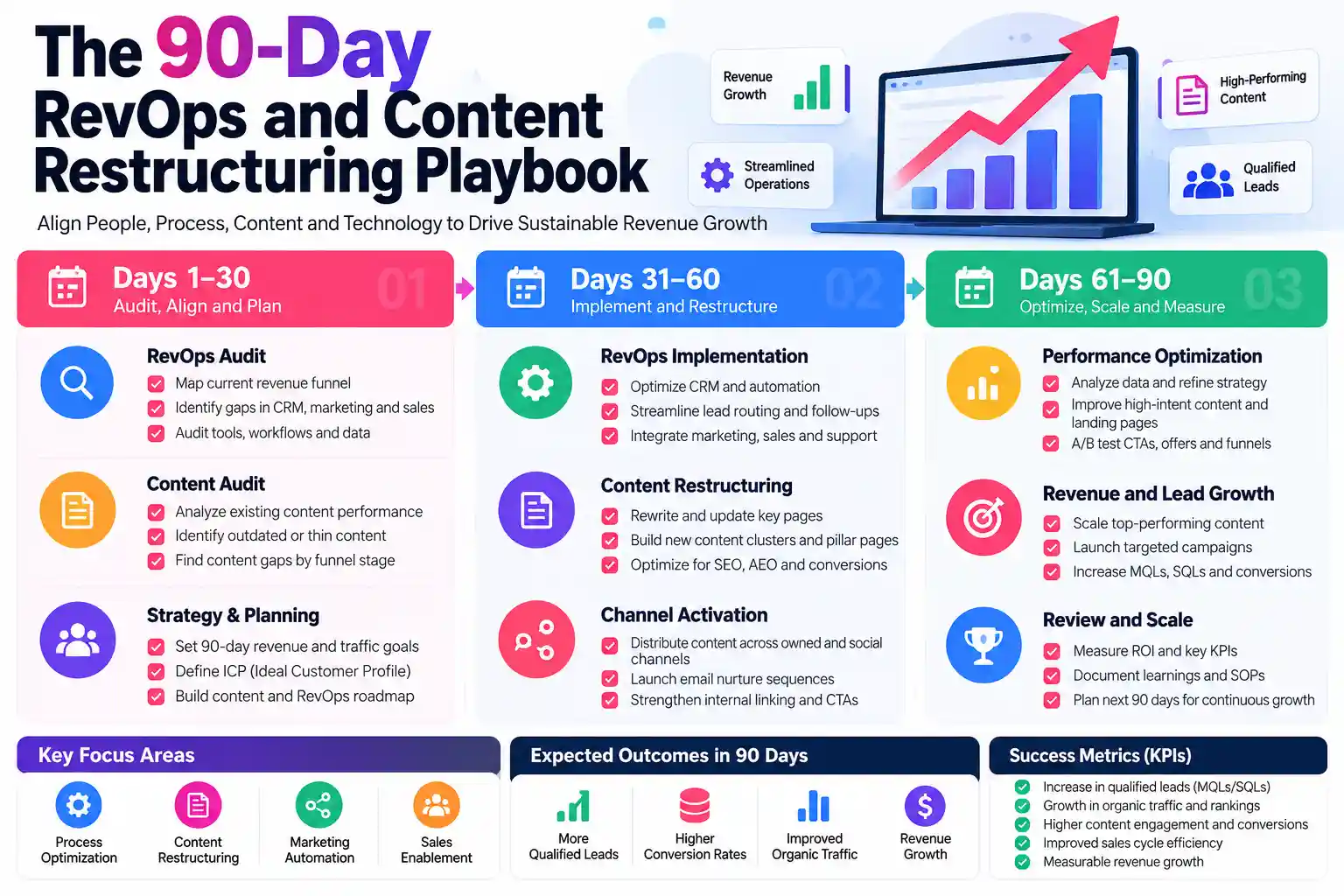
Days 1 to 30: Ruthless Content Triage
Export every URL on your domain from Search Console over the last twelve months. Filter for pages where impressions are steady or growing, click-through rate has collapsed by more than 50%, and assisted bottom-of-funnel conversions sit at flat zero. Stop paying writers or agencies to “update and optimize” those URLs. You are just feeding the machine for free. Take the top 20% that have strong backlink profiles, merge them into deep commercial comparison pages or interactive tool hubs, 301-redirect the rest, and delete the thin glossary bloat.
Days 31 to 60: Turn Sales Transcripts Into Public Training Data
Your best answer engine optimization assets are currently locked inside your Gong recordings, Chorus transcripts, and private Notion sales battlecards. Go pull the last forty closed-won and closed-lost enterprise deals. Write down the ugly, hyper-specific questions prospects asked about security architecture, hidden implementation costs, seat minimums, and competitor migrations. Turn those exact answers into public, crawlable technical pages. When you feed real sales enablement straight into the public index, the AI models train on your exact objection-handling scripts and repeat them verbatim to prospects before they ever talk to your reps.
Days 61 to 90: Rebuild RevOps Around Sales Cycle Compression
Sit down with your RevOps lead and build a cohort report comparing leads that self-report coming from AI search against your standard inbound leads. What you will see is wild: while overall top-of-funnel lead volume drops, bottom-of-funnel conversion rates and pipeline velocity skyrocket. Why? Because a buyer who spent forty minutes interrogating an AI engine about your product limits, pricing tiers, and API structure shows up to the first discovery call 80% educated. They don’t need a boring slide deck walkthrough. They skip straight to technical validation and procurement. Measure that sales cycle compression, tie it to your account-based marketing target lists, and walk into your next board meeting talking about faster net new ARR instead of whining about lost clicks.

Written by Anik Hassan
Founder @ dmanikhAnik Hassan is an SEO strategist — working in search engine optimization since 2013 — specializing in AI search optimization, topical authority, and organic growth systems. 87.31% success rate across 1.1k+ projects.
Have a question or a different take?
Send your thoughts — I read every message and love a good SEO debate.